
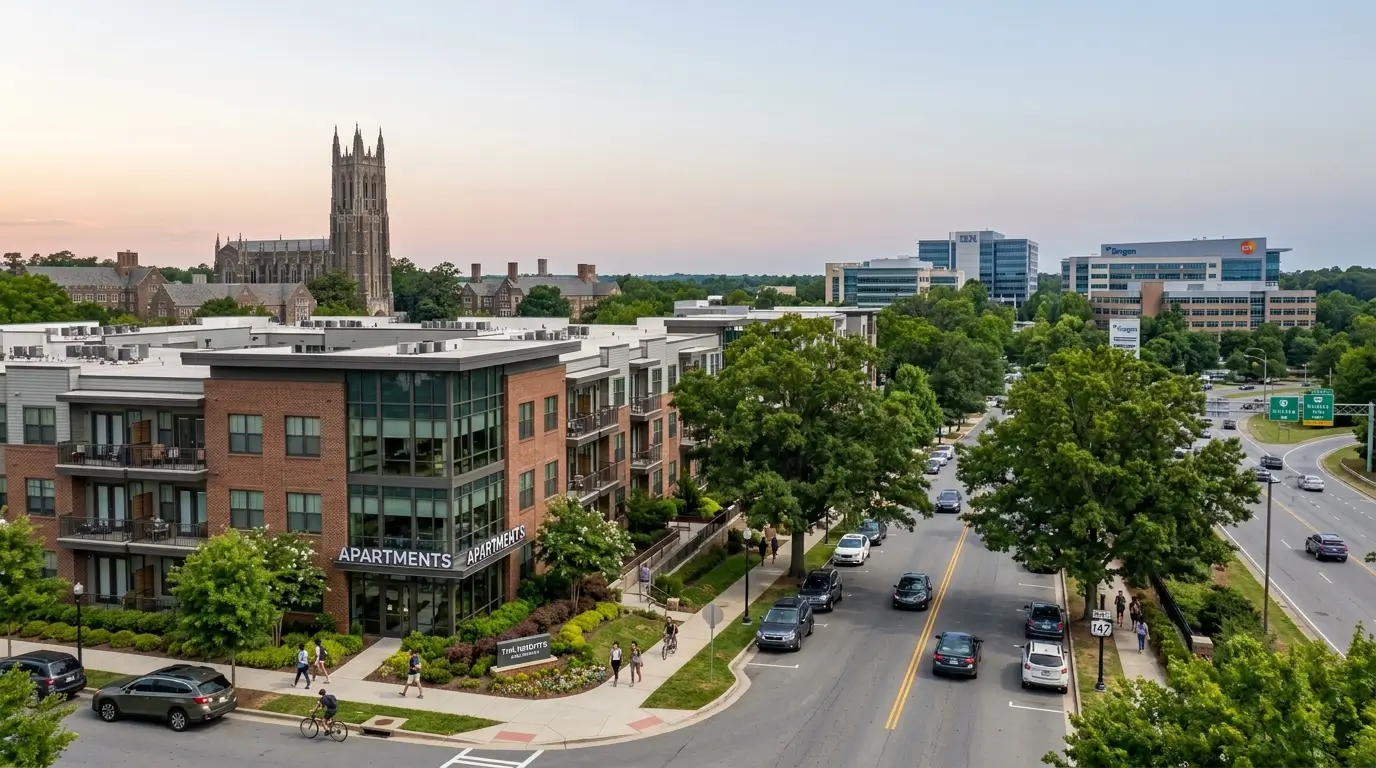
Durham's rental market has held up well compared to a lot of comparable Southeast cities in recent years, and the reason isn't a mystery. Two institutions, Duke University and Research Triangle Park, anchor a renter base that's large, diverse, and less dependent on any single industry than markets built around one employer. That said, strong underlying demand doesn't mean every individual property leases just as easily, and a wave of new supply moving through Durham right now means market-level fundamentals and property-level leasing performance are worth thinking about separately.
Key Takeaways
Duke University and Duke University Health System together employed 42,887 people as of 2022, the most recent figure Duke has published, and the university has continued hiring steadily since.
Research Triangle Park is home to roughly 55,000 employees and nearly 400 companies, generating an estimated $25.1 billion in annual economic impact, equivalent to about 4.1% of North Carolina's statewide GDP, with a tenant roster spanning tech, life sciences, and finance.
Durham's average rent stood at $1,800 a month as of June 2026, about 8% below the national average, though asking rents across the broader market are expected to soften during the second half of the year.
Net move-ins in Durham over the past 12 months equaled 3.8% of the market's roughly 65,000 units of housing stock, a sign that demand from Duke, Duke Health, and RTP remains real even as supply increases.
Durham developers have already pulled permits for more than 2,800 multifamily units this year, exceeding the market's five-year annual average of roughly 2,500 units, meaning owners should expect more competition for renters even where underlying demand is strong.
The Duke Effect: A Built-In Renter Base
Duke University and Duke University Health System together employed 42,887 people as of 2022, according to Duke's own reporting on its workforce, which cites Duke Human Resources directly. That figure doesn't include the tens of thousands of students who need housing every year, and Duke has continued hiring steadily since, having added roughly 21,500 new employees across the university and health system since the start of 2020.
Duke is also the largest employer in Durham County and the second-largest private employer in North Carolina, according to Duke Health's own facts and statistics page. That scale creates a renter base that includes students, graduate students, visiting faculty, medical residents, and health system employees, all drawing from the same stable institutional anchor.
Research Triangle Park's Scale
Duke isn't Durham's only demand driver. According to Research Triangle Park's own reporting, the park is home to roughly 55,000 employees and nearly 400 companies and national labs, generating an estimated $25.1 billion in annual economic impact. That figure is equivalent to approximately 4.1% of North Carolina's 2023 statewide GDP, according to Wake County Economic Development's reporting on RTP's economic impact study.
RTP's tenant roster includes Apple, BASF, Biogen, Cisco Systems, Fidelity Investments, IBM, Labcorp, Lenovo, and Eli Lilly, spanning technology, life sciences, and finance rather than concentrating in any single industry.
What Durham's Rent Levels Actually Look Like
As of June 2026, Durham's average rent sits at $1,800 a month, according to Zumper's own market data, which is roughly 8% below the national average and has stayed essentially flat over the past year. That relative affordability, paired with the steady demand Duke and RTP provide, is part of why Durham has continued to attract rental investment even as some neighboring Southeast markets have seen more volatility. Looking ahead, Northmarq's second-quarter 2026 Raleigh-Durham multifamily research projects that asking rents across the broader market will likely soften in the second half of 2026, continuing a pattern seen in each of the past four years, which is worth factoring into rent-setting even where a specific property or submarket is performing well.
Which Neighborhoods Benefit Most From This Demand
The demand from Duke and RTP doesn't stay confined to the immediate campus or park boundaries. Neighborhoods within easy commuting distance of both anchors, including areas near downtown Durham and the corridor connecting the university to RTP, tend to see the most consistent rental interest from this combined employee and student base.
Reviewing which submarket a given property actually falls into, rather than treating "Durham" as one uniform market, is exactly the kind of analysis our marketing team does before setting a rent price or launching a listing.
A Renter Base With Different Rhythms
One practical difference worth planning around is that Duke's academic calendar and RTP's corporate hiring cycles don't move on the same schedule. University-driven demand tends to cluster around the traditional academic year, with a heavier concentration of move-ins and move-outs in the summer months, while demand tied to RTP's employers is spread more evenly throughout the year and tends to follow hiring and relocation timing rather than a semester schedule.
A property that leans on both pools of renters, rather than positioning itself exclusively toward one or the other, has more flexibility in when it lists and how it prices, since it isn't entirely dependent on hitting the narrow window when student demand peaks.
More Supply Is Changing the Competitive Picture at the Property Level
Strong fundamentals at the market level and easy leasing at the property level aren't always the same thing, and that gap is showing up in Durham right now. According to Northmarq's Q2 2026 Raleigh-Durham multifamily report, net move-ins in Durham over the past 12 months accounted for 3.8% of the market's roughly 65,000 units of stock, a healthy pace that confirms Duke and RTP are still pulling renters into the market.
At the same time, Durham developers have pulled permits for more than 2,800 multifamily units so far this year, already exceeding the area's trailing five-year annual average of roughly 2,500 units. That report also notes that Durham's fundamentals have remained comparatively softer than Raleigh's, which has driven most of the region's recent vacancy improvement and investment activity, and that asking rents across the broader Raleigh-Durham market are expected to soften in the second half of 2026.
None of this undermines the Duke and RTP thesis. It does mean that a diversified, resilient renter base at the market level doesn't guarantee any individual unit will lease quickly or at the price an owner has in mind. With more product competing for the same pool of students, medical residents, and RTP employees, pricing accuracy, unit condition, and how a listing is marketed carry more weight than they would in a tighter market. In practical terms, that's the difference between counting on Durham's overall demand story and actively managing how a specific property competes within it.
What This Means for Property Owners
For owners, the practical takeaway is that Durham's rental demand isn't riding on a single industry the way some markets are, but that doesn't mean leasing is automatic either. A slowdown in tech hiring doesn't fully offset the stability Duke and its health system bring, and RTP's mix of life sciences, biotech, and technology tenants means no single sector's downturn defines the whole market. What has changed is how much competition a given listing faces, so it's worth pairing that macro resilience with property-level fundamentals.
It's also worth factoring into how a property is screened and leased, since a tenant pool this varied, students, medical residents, corporate relocations, and long-term professionals, benefits from a tenant screening process flexible enough to properly evaluate each of these applicant types on their own terms.
Our ROI calculator can help you run the numbers for a specific property against both the demand side of this market and the supply Durham is currently absorbing, rather than relying on general market sentiment, before you commit to a purchase or a rent adjustment.
FAQ
How many people does Duke actually employ?
As of 2022, the most recent figure Duke has published, Duke University and Duke University Health System together employed 42,887 people, and the university has continued hiring steadily since then.
Is Research Triangle Park's impact separate from Duke's?
Largely, yes. RTP is home to roughly 55,000 employees across nearly 400 companies spanning technology, life sciences, and finance, giving Durham a second, independent demand driver beyond the university itself.
How does Durham's rent compare to the national average?
As of June 2026, Durham's average rent was $1,800 a month, about 8% below the national average, according to Zumper's own market data, though asking rents across the market are expected to soften in the second half of the year.
Does RTP depend heavily on any single industry?
No. Its tenant roster includes major employers across technology, life sciences, and finance, including Apple, IBM, Biogen, Cisco, and Fidelity Investments, which helps insulate the park's overall employment base from a downturn in any one sector.
Does Durham's new supply undercut the Duke and RTP demand story?
Not really. Net move-ins in Durham over the past year equaled 3.8% of the market's roughly 65,000 units, showing demand is holding up. But developers have also pulled permits for more than 2,800 units so far in 2026, above the market's five-year average, and asking rents are expected to soften in the second half of the year. That points to a market-level story of resilient demand paired with a property-level story of rising competition, which is a different question from whether Duke and RTP still support the market overall.
Positioning Your Property Within This Demand Base
Durham's combination of Duke University and Research Triangle Park gives this market a genuinely diversified renter base that most rental markets simply don't have, and that demand is holding up even as new supply comes online. Understanding which submarket your property actually competes in, how it stacks up against the wave of new units hitting the market, and which tenant pool it's realistically drawing from makes a real difference in how it's priced and marketed.
Our team walks through this kind of submarket and competitive analysis with every new owner we onboard, so give us a call if you'd like a closer look at how your property fits into this picture.